
Cybersecurity expectations in Europe are shifting
NIS2 has moved from something European organizations were preparing for to an active part of the EU’s cybersecurity landscape.
The directive covers 18 critical sectors and introduces stronger requirements around cybersecurity risk management, incident reporting, and accountability.
But the bigger shift isn’t just about who is covered. It’s about what organizations are expected to demonstrate:
Can you detect a problem, respond to it, and show what happened?
And that brings us to one of the most overlooked parts of the equation:
You can’t respond to an incident quickly if you don’t know it’s happening.
Visibility matters
NIS2 requires covered organizations to submit an early warning within 24 hours of becoming aware of a significant incident, followed by a more detailed notification within 72 hours.
That doesn’t mean every outage is a reportable incident, and monitoring alone doesn’t make an organization NIS2 compliant.
But it does mean early awareness matters.
If something goes wrong Friday night and nobody notices until Monday when a customer complains, valuable response time has already been lost.
The faster you know something is wrong, the faster you can investigate and act.
Your suppliers are part of the risk picture
Modern businesses depend on services they don’t directly control: hosting providers, CDNs, DNS services, payment platforms, cloud providers, and third-party APIs.
If one of them fails, your customers may still experience the impact.
For example, your servers might be running normally while a CDN outage makes your website inaccessible. Internal monitoring may show everything is healthy, while customers see a very different picture.
That’s where external monitoring adds another layer of visibility.
Why external monitoring matters
Internal monitoring tells you what’s happening inside your infrastructure.
External monitoring answers a different question:
Can customers actually reach our services?
A server can be online while a website is unreachable. An API can be running while requests are failing.
Monitoring from outside your infrastructure gives you an independent view of what users are actually experiencing.
Where internetvista fits
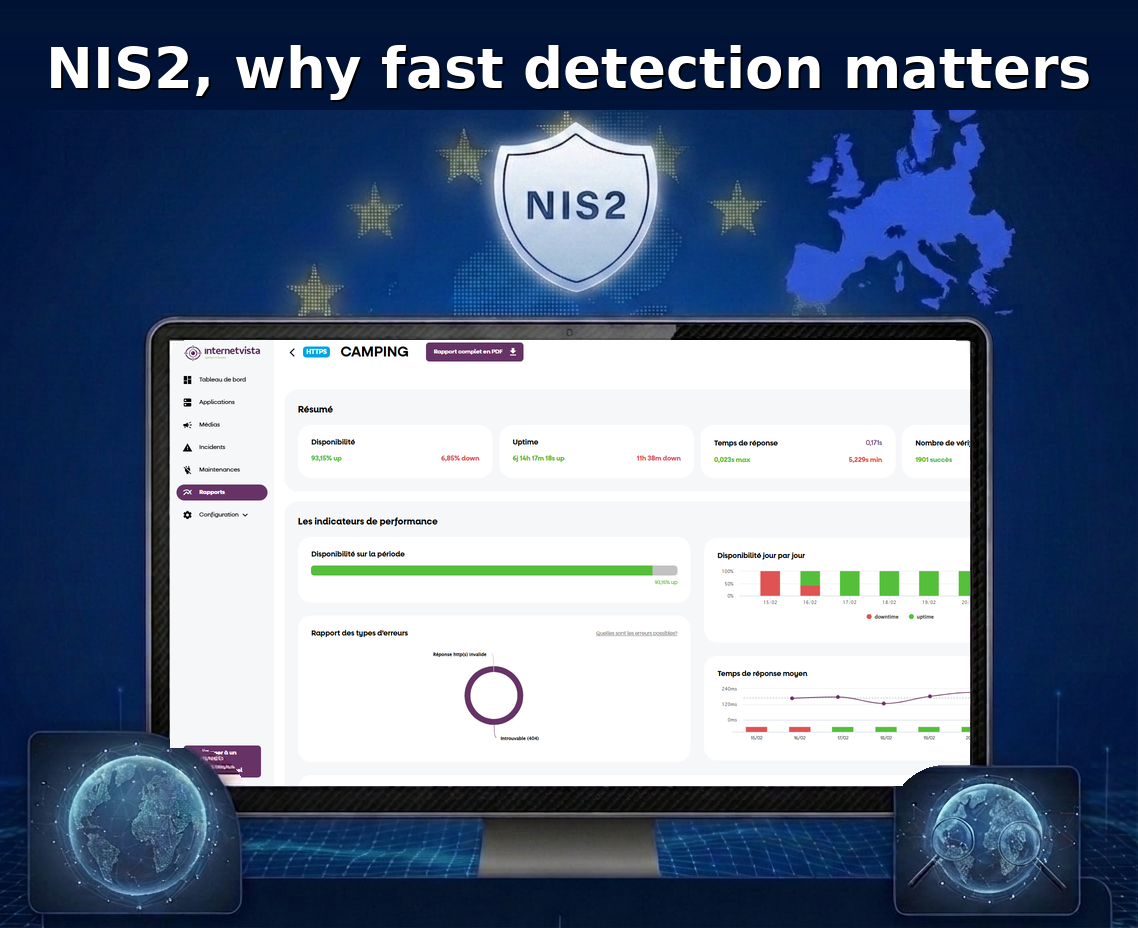
internetvista monitors websites, APIs, domains, and other online services from outside your infrastructure, helping teams detect availability problems before customers report them.
The goal is simple:
Something goes wrong → You know about it → Your team can investigate and respond.
It also provides an independent record of availability and incidents, with timestamps showing when a problem was detected, how long it lasted, and when the service recovered.
That information can help teams investigate incidents, identify recurring problems, and demonstrate how they responded.
Monitoring isn’t NIS2 compliance
internetvista does not make an organization NIS2 compliant.
NIS2 covers much more than monitoring, including risk management, incident handling, business continuity, supply-chain security, and governance.
NIS2 also doesn’t require organizations to use a particular monitoring tool.
What monitoring can provide is visibility, an important part of knowing when something has gone wrong and giving your team more time to respond.
The bigger picture
NIS2 reflects a broader shift in European cybersecurity: organizations are increasingly expected to demonstrate that they can identify problems, respond to incidents, and understand the risks across the services they depend on.
The Cyber Resilience Act is moving in a similar direction for products with digital elements, with reporting obligations for certain vulnerabilities and incidents.
The goal isn’t to prevent every incident.
It’s to know when something is wrong and respond as quickly as possible.
Not as a replacement for your NIS2 program, but as part of the visibility underneath it.
Because when something goes wrong, the earlier you know, the more time you have to act.
Ready to improve your visibility?
See what’s happening from outside your infrastructure and detect availability issues before your customers do.
Try internetvista free for 30 days →
No credit card required. Start monitoring your websites, APIs, and online services today.